 Curbfeed
How Curbfeed Onboards a Brokerage in About a Minute Without Building a Social Platform Layer
See how Curbfeed, a real estate marketing platform, runs its entire automated office-level publishing pipeline on Ayrshare.
Curbfeed
A real estate marketing platform that turns MLS listing events into branded videos and social posts for brokerage offices, with agents never logging in to anything.
Industry
Real Estate / Marketing
HQ
United States
On Ayrshare
Since Feb 2023
Case study content
Share Case Study
Ask AI about this article
Opens your AI assistant in a new tab with this article preloaded.
>99%
Post delivery success rate
7+
Platforms live through one integration
2,071,326
Publish API calls since February 2023
TL;DR
Curbfeed automates social publishing for brokerage offices by making the software effectively invisible to agents. Using Ayrshare as its publishing infrastructure layer, the platform onboarded new offices in about a minute, delivered posts across 7 social platforms, including Facebook, X, Instagram, Threads, YouTube, TikTok and LinkedIn, with more than 99% reliability and scaled to support thousands of offices without expanding its social platform engineering team.
The Real Challenge Was Agent Adoption
In real estate marketing, the hardest problem usually isn't publishing content; it's getting hundreds of real estate agents to consistently use the software in the first place.
Curbfeed, a US-based real estate marketing platform, solved that by making the software effectively invisible.
Brokerages sign up, listings are automatically published to social media, and agents never log in to anything. The platform handles SMS alerts, virtual tours, listing videos, AI-assisted property descriptions, and automated social publishing, all running in the background on transactional events from the MLS. Curbfeed also automates video creation from the listing photos and posts, both still images and videos.
We spoke with Danny Colavito, Curbfeed's founder, about how the platform handles social publishing for hundreds of agents per office without a single agent ever touching it, and how Ayrshare made that possible without consuming his entire engineering team.
How Curbfeed Automates Brokerage Marketing Behind the Scenes
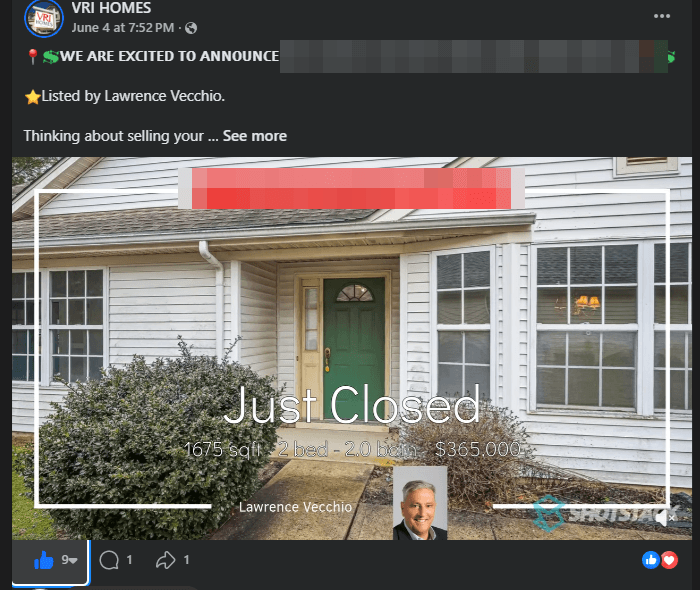
Curbfeed connects to a brokerage's MLS through supported APIs such as the Flexmls Spark API and monitors transactional changes for every listing in that office. A new property goes live, a price changes, an open house is scheduled, an offer is accepted, and a deal closes.
Instead of relying on agents to manually market those updates, Curbfeed automates the entire publishing process behind the scenes. Each event triggers an automated workflow:
- Listing data and media flow into Shotstack, which renders a branded video for the office.
- Curbfeed's content automation, including an AI-assisted layer for property descriptions, generates the accompanying post copy.
- The completed video and caption are handed off to the social publishing layer for delivery across the office's seven connected networks.
Invisible Automation Created an Infrastructure Problem
That automation model created a second challenge: maintaining a reliable publishing infrastructure across thousands of transactions and hundreds of agents, with the number of agents quickly growing. When Danny started building the social publishing layer, he initially explored building direct integrations with Facebook, X, LinkedIn and other platforms. He also evaluated several social API providers.
Most of the options he reviewed either weren't designed for multi-tenant SaaS products, introduced per-seat pricing that didn't fit a brokerage model, or still pushed platform maintenance complexity back onto his team. What Curbfeed needed wasn't another product surface to manage; it needed infrastructure that disappeared into the background.
Three technical realities made direct integrations unattractive from the start:
Multi-Tenant From Day One
Hundreds of office-level social accounts need isolated OAuth tokens, refresh cycles, and rate-limit budgets per tenant. Building that from scratch is not a one-time integration.
Three Core Platforms, Three Breaking-Change Cadences
Facebook, X, and LinkedIn each evolve their APIs on their own schedule. Each change lands on the product team in the middle of feature work, compounding across every tenant.
Silent Failures Are Unacceptable
With agents never logging in, a missed post is a missed listing. Accumulated failures erode brokerage trust before anyone catches them.
If we'd built the social integrations ourselves, we'd be a smaller team shipping a smaller product, with engineers stuck on platform plumbing instead of real estate.

Danny Colavito
Founder, Curbfeed
Why Curbfeed Chose Ayrshare as Their Publishing Layer
Rather than turning Curbfeed into a company maintaining social platform infrastructure, they needed a way to support hundreds of brokerage offices without adding platform-specific engineering overhead.
Ayrshare handles that through three core capabilities.
1. Automated Publishing Without Maintaining Platform-Specific Integrations
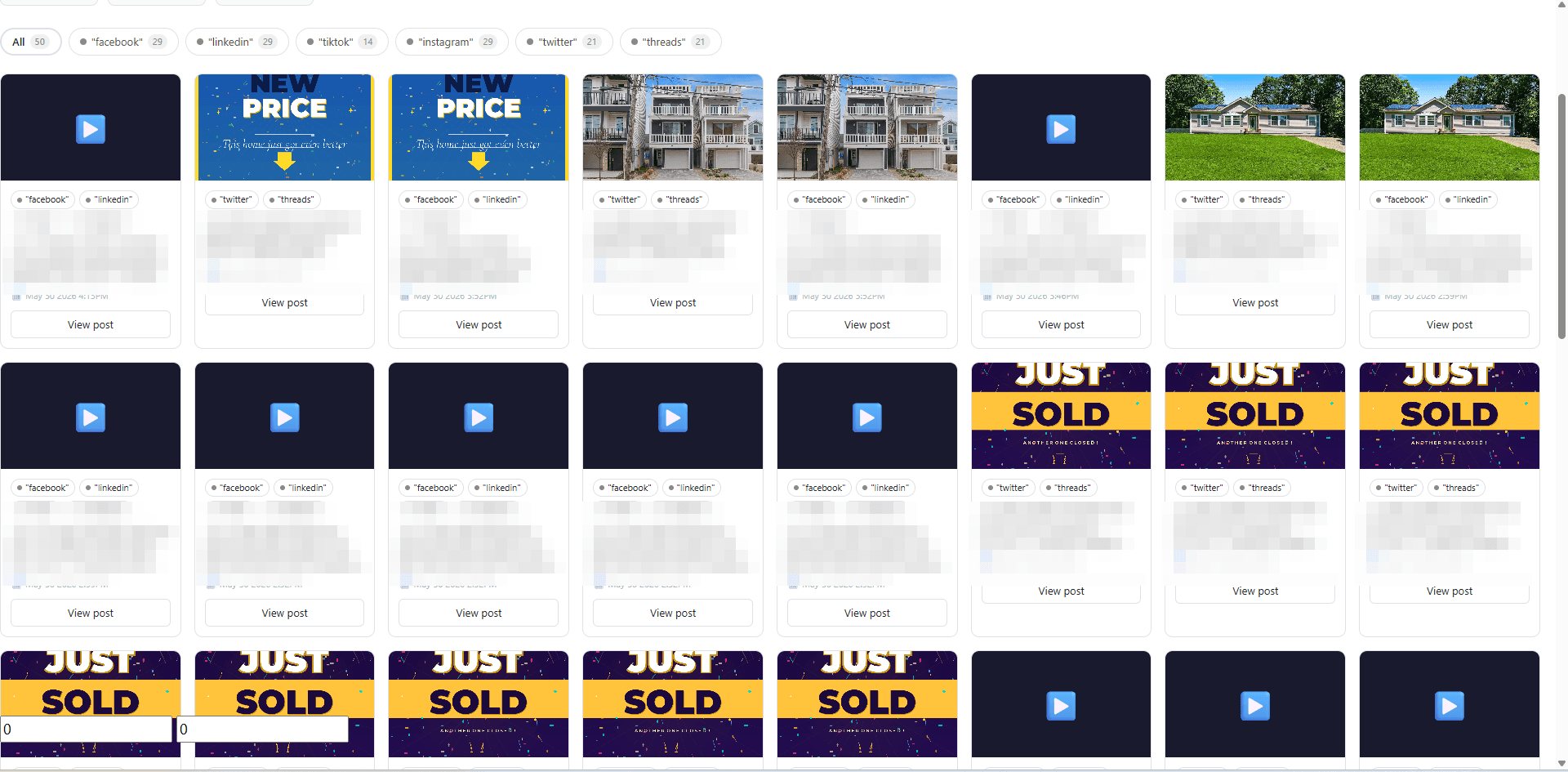
Every completed video and caption generated by Shotstack is sent to Ayrshare via callback. Ayrshare then publishes to the office's connected accounts across all seven networks.
Curbfeed gets reliable delivery across seven networks without maintaining platform-specific publishing code. When Facebook, X, LinkedIn, or any other network changes something, the fix happens on Ayrshare's side, not Curbfeed's.
2. Office-Level Isolation That Works at Brokerage Scale
Each brokerage office is a tenant in Ayrshare's Business Plan, with isolated OAuth tokens, independent rate-limit budgets, and per-tenant post history.
This is what makes the "invisible to agents" model work at scale. The architecture can handle hundreds of independent offices the same way it handles four. Adding a new office takes about a minute and requires only six fields. Authentication, token refresh, and concurrency control all happen at the infrastructure layer.
3. An Optional Approval Workflow for Offices That Want It
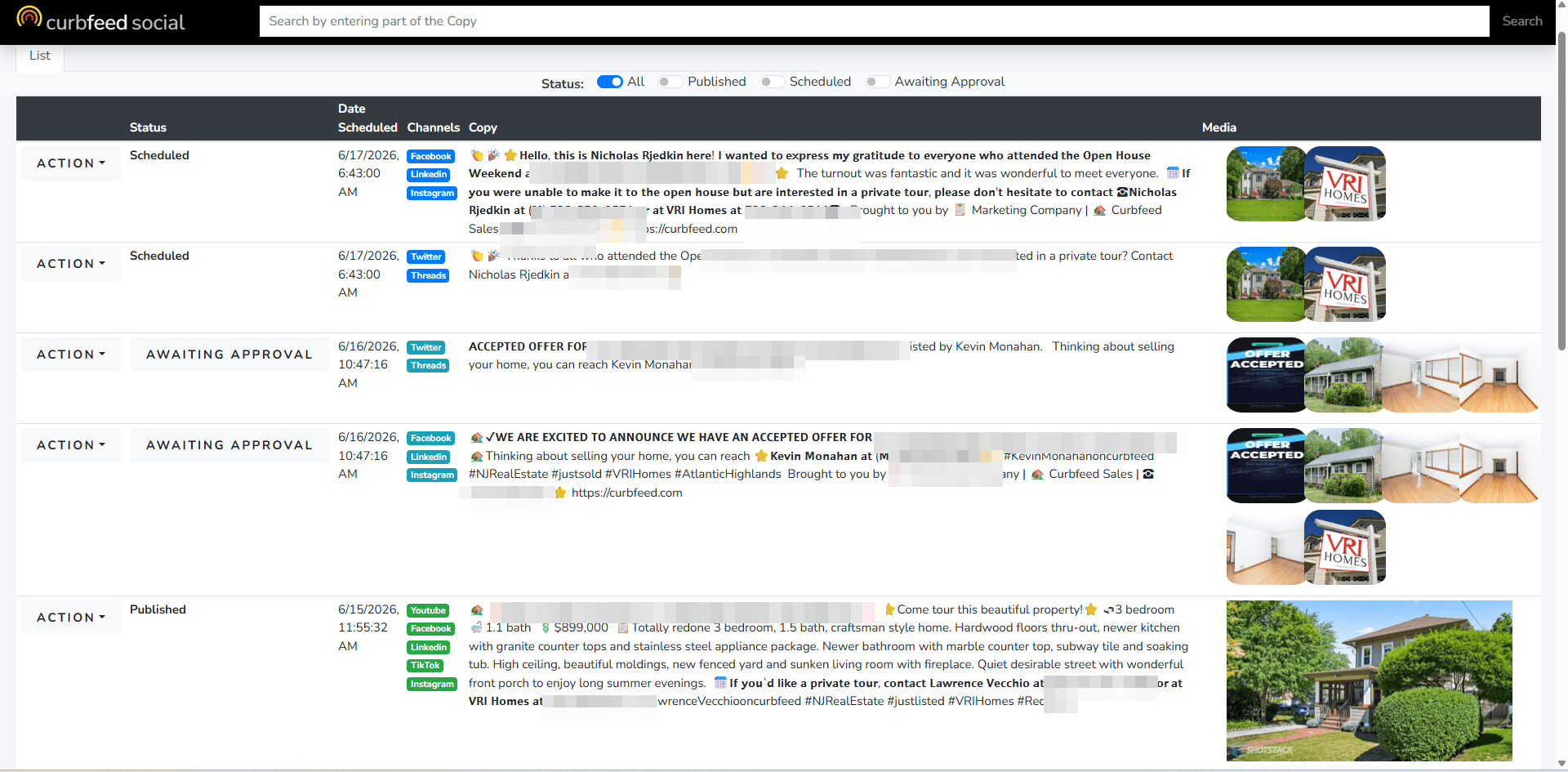
Offices that prefer more control can enable a review step before anything goes live. When Curbfeed generates a post for a listing, the agent receives a text notification with a link to preview the content and a single button to approve it, triggering distribution across every connected platform.
Curbfeed builds this on Ayrshare's built-in approval workflow and callback notifications. Once a post goes live, agents receive a text with direct links to the content on each network, making it easy to like, comment, and share. That immediate agent engagement is what moves a listing from posted to amplified.
What Changed After Curbfeed Moved Publishing Infrastructure to Ayrshare
| Without Ayrshare | With Ayrshare | |
|---|---|---|
| Social integrations | Seven direct integrations (Facebook, X, LinkedIn, Instagram, TikTok, Threads, YouTube), maintained per tenant | A single API covering 14+ networks |
| Onboarding a new office | Custom OAuth flow, token storage, and rate-limit logic per tenant | About a minute, six fields, one click |
| Multi-tenant scale | Custom architecture for office-level isolation | Business Plan architecture handles isolation natively |
| Platform API changes | Each breaking change lands on the Curbfeed product team | Absorbed by Ayrshare before it reaches Curbfeed |
| Engineering allocation | Significant share of engineering time on platform plumbing | Engineering focused on the real estate workflow |
Ayrshare runs our entire publishing layer. One API call posts to every network, straight to our clients' own pages, which is what real estate offices need. If you're building social automation, Ayrshare should be your first call.
Danny Colavito
Founder, Curbfeed
The Result: Brokerage-Scale Publishing With Minimal Operational Overhead
Today, with Ayrshare, onboarding a new brokerage takes about a minute. A broker fills in six fields, links social accounts, and listing monitoring starts immediately. From that point forward, every transactional listing event automatically becomes a published post across all seven connected networks, while the agents themselves never log into anything.
Roughly 99% of posts are delivered successfully. When a post does fail, it's usually a recoverable issue: an occasional account that needs re-authorizing, or content that doesn't fit a particular network's requirements, and Ayrshare returns clear guidance on what's wrong and how to fix it. The NJ MLS deployment, approximately 14,000 agents across thousands of offices, requires Curbfeed to add zero engineers dedicated to social platform work.

Our whole edge is automation. Agents never log in; their listings just show up across their social accounts. Ayrshare handles publishing, so we stay focused on real estate instead of maintaining the integrations ourselves.
Danny Colavito
Founder, Curbfeed
The division of labor is simple: Ayrshare handles the platforms; Curbfeed handles real estate.
What's Next for Curbfeed
The current architecture is already supporting the next stage of Curbfeed's growth. The NJ MLS deployment marks a major step change in scale, and Danny is building toward it on the same underlying architecture.
The roadmap goes beyond adding networks. Engagement is becoming a first-class feature, with auto-posted comments designed to drive interaction from the moment a listing goes live. On the MLS side, more listing announcement types are on the way, giving offices more opportunities to show up in front of buyers and sellers. And for offices, sponsored post integration is coming. This will allow agents to feature preferred partners like title companies and mortgage brokers directly within their listing content.
If a brokerage segment moves toward a network Curbfeed doesn't publish to yet, Ayrshare's 14+ supported networks mean it gets linked during onboarding. The engineering focus stays on the real estate workflow.
Interested in running automated social publishing for your product without building the platform layer yourself? See how Ayrshare's Business Plan works.
Curbfeed
A real estate marketing platform that turns MLS listing events into branded videos and social posts for brokerage offices, with agents never logging in to anything.
Industry
Real Estate / Marketing
HQ
United States
On Ayrshare
Since Feb 2023
Ask AI about this article
Opens your AI assistant in a new tab with this article preloaded.
Common Questions About Multi-Tenant Social Publishing
Platform changes land on Ayrshare's side first. When a network updates how it accepts video content, modifies a token format, or shifts how it enforces rate limits, Ayrshare updates the integration. Curbfeed's product team doesn't ship per-change engineering responses or pull engineers off the real estate roadmap. The X BYOK migration in March 2026 is a recent example: Ayrshare shipped migration tooling ahead of the deadline, so Curbfeed's X publishing kept running without any action on their side.
Facebook, X, and LinkedIn are the three core platforms where brokerages maintain their listing presence, and Curbfeed also publishes to Instagram, TikTok, Threads, and YouTube, for seven networks in total. Ayrshare supports 14+ networks, all powered by the same API. If a brokerage segment moves toward another network in the future, it gets linked during onboarding. There is no parallel platform integration to build on Curbfeed's side.
Ayrshare's pricing is based on the number of active social profiles managed, not seats and not per post. Each brokerage office Curbfeed runs is one profile, regardless of how many agents sit inside it or how many listings are published in a given month. Curbfeed's Ayrshare cost scales on the same axis as revenue (brokerage count), rather than ahead of it.
Any product where social publishing is a feature inside a vertical SaaS, with end users who never need to see the social side directly. Property management platforms, franchise marketing tools, automated marketing for real-estate-adjacent verticals (insurance, mortgage, title), and agency tooling all fit the same shape. The common pattern is a platform managing many independent accounts with separate brand identities, where engineering resources are better spent on the vertical workflow than on maintaining social platform infrastructure.